Most failed microservice migrations begin with services split along technical layers instead of business meaning. Domain-driven design gives you a more durable knife: the bounded context, a boundary inside which a model and its language stay consistent.
Why Language Reveals Boundaries
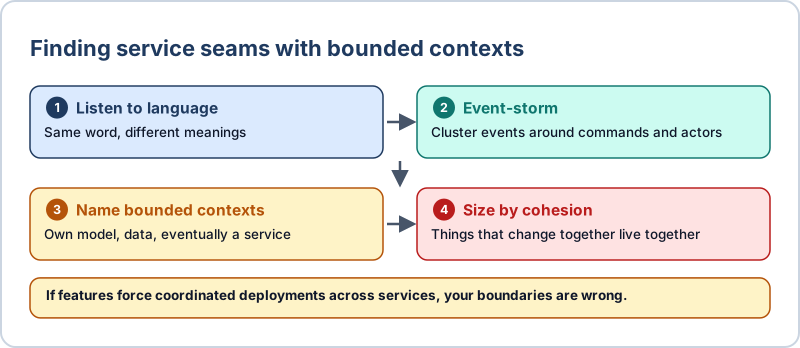
Listen to how different teams use the same word. In an e-commerce domain, an order means something different to fulfillment, billing, and support. When one term carries several meanings, you are looking at separate bounded contexts. Each context deserves its own model, its own data, and eventually its own service, rather than one bloated Order class serving every department badly.
Mapping Contexts Before Cutting Code
Run an event-storming session before writing any migration code. Put domain events on a wall, cluster them around the commands and actors that produce them, and watch natural groupings appear. Those clusters become candidate services. The exercise costs a day and routinely prevents months of rework caused by splitting a domain where it does not actually bend.
Sizing Services by Cohesion Not Lines of Code
There is no correct number of endpoints or lines per service. The test is cohesion: things that change together should live together. If every feature request forces coordinated deployments across three services, your boundaries are wrong regardless of size. A larger service with one clear responsibility beats several tiny services entangled in each other’s release cycles.
Action Step
Pick one domain in a system you know and list five terms the business uses daily. For each term, note which teams define it differently. Sketch the bounded contexts those differences imply and mark which one you would extract first.
Educational content only. System and continuity designs must be validated against your own organization’s requirements, testing, and current vendor documentation. This course does not certify anyone.